A 76-Year-Old in a Baniyan Got a Million Views: Why This Reel Worked
In July, Ritush posted a reel about a 76-year-old man lifting weights in a vest. It has no before-and-after photo, no offer and no trending sound. It has crossed a million views on his page.
Ritush coaches people online under the name Wholistic. We edited the reel. It is 64 seconds long, and it is worth taking apart, because nothing in it is expensive and almost all of it can be copied.

- It opens on its strongest fact: a man of 76 out-training people half his age.
- The middle is a list of things he does not use, and every one of them is shown.
- It ends on a comparison, not a pitch. The offer sits in the caption.
The subject does the work
The man is the actor Nana Patekar. The footage of him training is not ours and not Ritush's: the caption credits Atul Kasbekar for it. What the reel adds is a reading of that footage. In Ritush's words under the post: "Somewhere along the way, we confused consuming fitness with doing fitness."
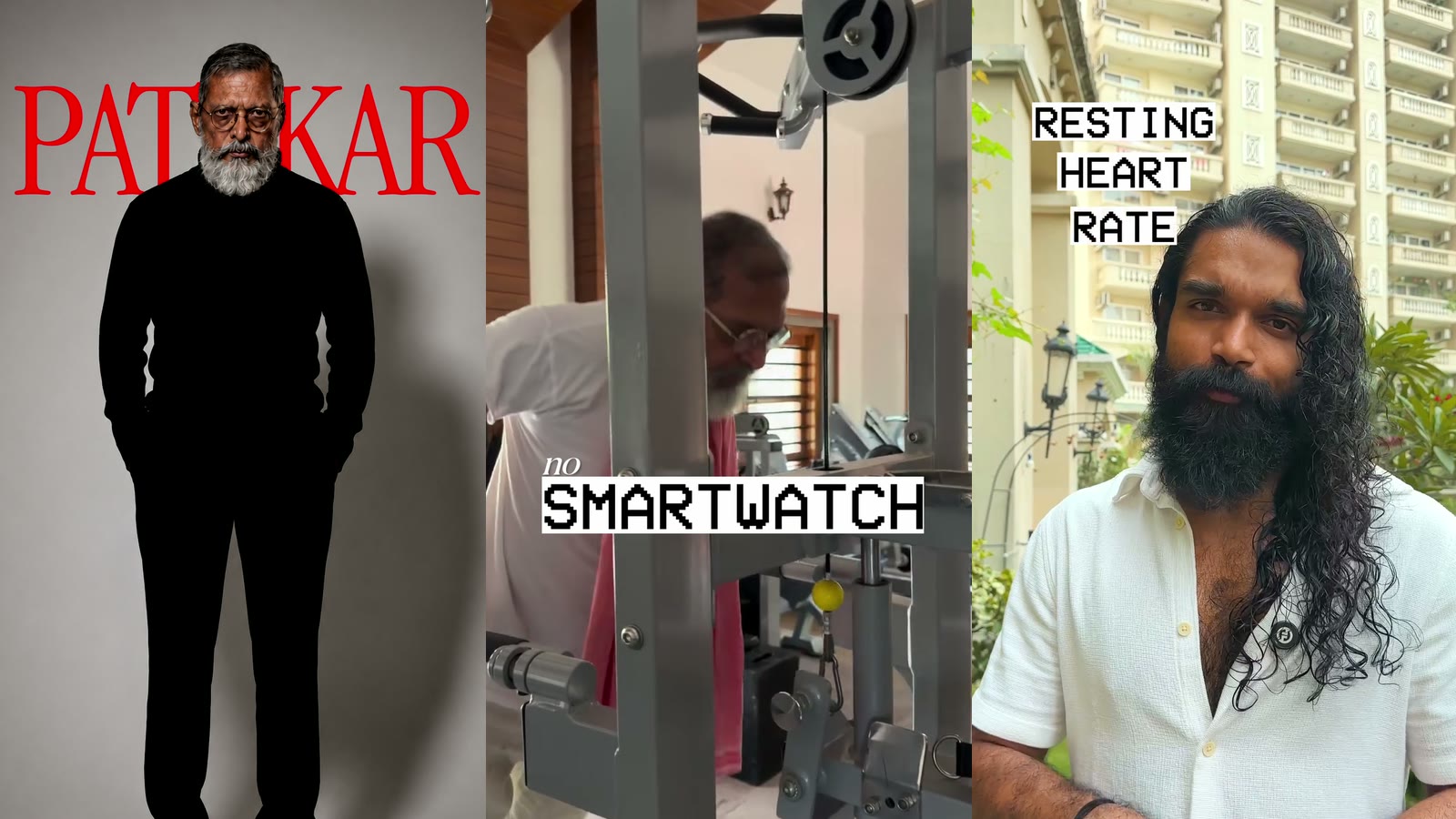
The first three seconds already carry that idea. The cover is set like a magazine, his name in red letters over a still of him in black. The opening line puts him against a generation that "calls pickleball a workout". You know who the reel is for, and what it thinks, before the fourth second.
A list of no
Then comes a list. No pre-workout. No smartwatch. No Lululemon. No "day one of my fat loss journey". No two-hour routines. No Instagram aesthetics.
Each "no" lands on a cut, and the thing being dismissed is on screen as it is named. A list like this is easy to write and easy to get wrong in the edit: if the pictures lag behind the voice, it turns into a lecture. Here no item stays longer than its word.
Against the list stands what he does use: a "breathable baniyan", a gym machine, and "moving his body consistently for years".
The turn
Halfway through, the reel stops being about him and starts being about the viewer. Somewhere along the way, it says, something simple was made complicated: "the shoes, the supplements, the gadgets, the endless debate about the perfect routine".
And then what fitness was "before it became an industry": move, repeat, and do it better tomorrow.
When life gets hard, simple survives.
from the reel
Where the coach is
Ritush himself does not appear for the first quarter of the reel, and for about two thirds of it he is not on screen at all. When he is, he is talking to his phone outdoors, in short stretches between the footage. The idea leads, and the coach comes in to land it. For a coach's page that is unusual, and we think it is a large part of why people passed the reel on: it reads as a point of view, not as an advertisement for a programme.
The ending is a comparison, not a pitch. The man of 76 in his baniyan is set against a 30-year-old who tracks his resting heart rate, his sleep and everything else, and "still throws out his back lifting his young daughter". Nobody is told to buy anything. The offer, one line asking people to message him, sits in the caption.
What the edit does
- Words on screen, one or two at a time. Large, and timed to the voice. Most reels start with the sound off, and this one can be read from the first frame.
- The things it argues with are shown by name. The smartwatch, the supplement tub, the brand names. Viewers recognise their own shopping basket.
- No scene outstays its line. When the sentence ends, the picture changes.
What to take from it
Start with the most surprising true thing you have. Make every item of a list visible. Let the idea be bigger than the person presenting it, and put the offer where people look once they have decided they like you: the caption.
None of this needs a studio. It needs a point of view that someone will repeat to a friend. This one fits in five words.
Ritush on working with us
 RitushWholistic
Manish has been a great professional to work with.
He brings a keen eye for detail, an ability to think beyond the brief, and a genuine commitment to his craft.
What has been particularly inspiring is watching him evolve, not just in his skills, but also in how he organises his work, builds his team, and continually improves the efficiency and quality of what they deliver.
He’s an inspiring young professional who, along with his very capable team, is constantly finding ways to grow while helping his clients do the same.
I would highly recommend working with him.
Why a simple reel about a real person can travel far
The reel in this post is 64 seconds about one man doing one thing. It has no offer in it and no trending sound, and it has crossed a million views on Ritush's page. We cannot tell you that a reel like it will do the same on yours. Nobody honestly can. What we can do is explain why this kind of reel is easy to pass on, because that part is craft, and craft can be learned.
A person is easier to share than a tip
When people send a video to a friend, they usually send it with a sentence in mind. Look at this man, he is 76. A tip needs explaining. A person does not. When a reel is about somebody real doing something you can see, the sender does not have to add anything. The reel is the message.
It also helps when the person on screen is not the one posting. Someone who says their own method works is selling. Someone who points at another person and says look is making an observation. The same idea is heard differently when the presenter steps to one side. That is what happens here: for much of the reel the coach is not on screen at all.
One idea, said plainly
A simple reel has one idea. Not three points and a summary. One. The test is whether a viewer could tell a friend what it was about without watching it a second time. The point of view in this reel fits in five words. If yours needs a paragraph, it is two reels, or it is not ready yet.
Real footage reads as proof
Polished footage tells a viewer that somebody made an effort. Plain footage of a real moment tells them that it happened. For a reel that argues something, the second is worth more. A man of 76 lifting weights in a vest is believed in a way that a staged shot would not be.
This is why a simple reel does not need an expensive shoot, and is often better without one. It needs a true subject, a clear idea and an edit that stays out of the way. It is also why you have to be careful about what you choose. The footage is doing the proving, so it has to be real, and it has to show what you say it shows.
Who this kind of reel works for
Not only coaches. A bakery can make a reel about the man who has delivered its flour for as long as anyone remembers. A cycling club can make one about its oldest member on the Sunday climb. A bookshop can make one about the customer who has read every book on one shelf. In each case the business is in the reel only at the edges, and the idea is bigger than the business.
What these have in common is a real person, something they do that can be filmed, and a reason a stranger would care. If you have all three, you have the start of a reel. If you have only the first two, you have a nice clip.
How to find the story in footage you already have
Many people who say they have nothing to post have a phone full of footage. What they do not have is a story. A story is not found by filming more. It is found by looking at what is already there with one question in mind: what in this would surprise a stranger.
Watch everything once, with the sound off
Sit down with the footage and watch all of it without stopping and without sound. Do not edit yet. Write down every moment where you looked up. A hand that shakes and then steadies. A laugh. A thing done the old way. Those are your pictures. A reel is built from the moments that hold the eye, and you find them faster when no voice is telling you what matters.
Write the most surprising true thing in one line
Now write one sentence that is true and that a stranger would not expect. This reel opens on its strongest fact: a man of 76 out-training people half his age. For the bakery it might be: he has not missed a morning since the shop opened. For the cycling club: she learned to ride at sixty. If you cannot find a line like that, the footage may be pleasant to watch, but it is not a reel yet.
Find the contrast
A fact is stronger next to its opposite. This reel sets a list of things its subject does not use against the few things he does. Your contrast might be old and new, slow and fast, one person and a crowd, or what people expect and what is true. The contrast gives you the middle of the reel, because it gives you two kinds of picture to cut between.
Decide what the viewer should think at the end
A profile with no point is a slideshow. Decide what you want a viewer to think when the last frame goes dark, and write that down as well. Not what you want them to buy. What you want them to think. Every shot you keep should help that thought. Every shot that does not should go, however much you like it.
Check that you have enough pictures
Count the things your script names. Each one needs something on screen while it is being said. If the script lists five things and you have pictures for three, cut the list to three or find two more pictures. A named thing with nothing to look at is a weak spot in the reel.
On our own projects this is the work of the script call, which shapes each script and decides how it will be shot. The steps are on our Services page.
Put it in an order
You now have a surprising line, a contrast and an ending. That is already an order: open on the line, spend the middle on the contrast, and close on the thought you want to leave. Write it as a list of five or six beats on one page before you start cutting. Editing goes faster, and ends better, when the order exists first.
How to open a profile reel in the first two seconds
The opening has one job: to give a person a reason to stay. In a reel about a real person you already have that reason. It is the surprising true thing you wrote down. Put it first.
- Start on the subject, not on yourself. The first frame should be the person the reel is about, doing the thing. Your own face can wait.
- Say the fact at once. The first line is the surprising one. No greeting, no series name, no warming up.
- Put the words on screen from the first frame. Edit as if the sound is off. If the opening cannot be read, a silent viewer has been given nothing.
- Make the cover do the same job. The still that people see on your page should carry the name or the fact in large letters. The cover of this reel is set like a magazine, with the name over a still of the man.
- Promise only what the footage holds. If the first line is bigger than what follows, the viewer feels let down by the tenth second.
A quick check: watch your first two seconds with the sound off and your thumb over the caption. If what is left says nothing, the opening is not ready. We describe that test, and how we build openings, in our post on the first two seconds.
One more thing about openings in tributes. It is tempting to begin with a title card: a name, a date, a fade from black. That is how films about people begin, and a film has an audience that has already sat down. A reel does not. Start inside the action and let the name arrive in the first line.
How to edit a short tribute or profile reel
Editing a reel like this is mostly a matter of what you leave out. Four things have to be right: the pace, the restraint, the words on screen and the sound.
Pacing: no picture outstays its line
The rule in this reel is that when the sentence ends, the picture changes. It is a good rule for any reel built on a voice. It keeps the eye and the ear in step, and it stops a shot from sitting on screen after it has done its work.
Lists need the most care. Each item should land on a cut, and the thing being named should be on screen as it is named. If the pictures run behind the voice, the list turns into a lecture. Cut a list to the rhythm of the words, not to the rhythm of the music.
Then slow down once. A reel that moves at one speed from start to finish is tiring to watch. Find the line that carries the idea and give it room: a longer shot, a breath before it, nothing else on screen. One slow moment in a quick reel is the one that stands out.
Restraint: what to leave out
A tribute is about someone else. Every effect you add is a small step back towards yourself. So leave out the zoom that has no reason, the shaking title, the sound effect on every cut and the filter that makes real footage look like an advertisement. If the footage is plain, let it be plain. Plainness is part of why it is believed.
Leave out the pitch as well. This reel ends on a comparison, and the offer sits in the caption as one line. A viewer who has just watched a tribute does not want to be sold a programme in the next breath. Put the offer where people look once they have decided they like you.
And leave out anything you cannot stand behind. Do not add a claim about the person that the footage does not show. Do not guess at what they eat, how they live or what they believe. Say what can be seen, say what you think it means, and keep the two apart.
Captions: one or two words at a time
In this reel the words appear one or two at a time, large, and timed to the voice. That does two things. A viewer with the sound off can follow from the first frame. A viewer with the sound on is carried along by the rhythm of the words.
- Keep the words clear of the face, and clear of the edges of the screen where the platform puts its own buttons and text.
- Use one typeface and one or two colours. Save the second colour for the word that matters.
- Check every word against the voice. A caption that differs from what is spoken is a distraction.
- Spell names correctly. In a reel about a real person, a misspelt name undoes the respect the reel is trying to show.
- Watch the finished reel once with the sound off. If it still makes sense, the captions are doing their job.
Sound: the voice first, then very little
This reel has no trending sound. In a tribute the voice is the sound. Clean it, keep its level steady from cut to cut, and let it sit in front of everything else.
If you use music, choose it for the mood of the subject, keep it low, and bring it down further whenever someone speaks. If the original footage has sound of its own, such as footsteps or the noise of a room, a little of it under the voice makes the pictures feel present. Silence is a choice too. A second without music before the last line gives that line weight.
There is more on the layers of a mix, and on why thin sound makes a whole video feel cheap, in our post on sound design.
Length: as long as the idea, no longer
This reel runs 64 seconds, which is what an opening fact, a list, a turn and an ending took. Yours may need twenty seconds or ninety. Write the script, read it aloud at an easy pace and time it. Then cut every line that repeats an earlier one. What is left is the right length.
How to credit footage that is not yours
The footage of the man training in this reel is not ours and not Ritush's, and the caption says so: it credits Atul Kasbekar for it. If you build a reel on footage that somebody else filmed, this is how we would go about it.
Start by asking. A credit is honest and it is good manners, and where you can reach the person who filmed something, ask them before you build on it and keep the reply. What you may use also depends on the platform's own rules and on the law where you live. This is practical advice from editors, not legal advice. If the reel matters to your business and you are unsure, ask someone qualified.
Before you use it
- Find the original. Not the account that reposted it. The person who filmed it, or the page that published it first.
- Ask where you can. A short, polite message that says what you want to make and where it will be posted. Keep the reply.
- See what the platform offers. Some platforms have their own way of building on another person's video that keeps the original attached. Where that exists, the link to the source stays clear.
- Think about the person on screen as well as the person behind the camera. Being filmed is not the same as agreeing to appear in your marketing. Do not make it look as if they recommend you.
When you post it
- Name the source in the caption, near the top. By name and by handle, in words a reader cannot miss: footage by, filmed by, original video by.
- Say what is yours and what is not. If the voice and the edit are yours and the footage is not, say so.
- Leave their marks alone. Do not crop out a watermark or a logo. Do not blur a name.
- Do not sell on the back of it. A reel built on borrowed footage is a poor place for a hard pitch. Keep the offer out of the video.
- Add something of your own. A reading, an argument, a point of view. If all you have done is repost, you have added nothing, and you should share the original instead.
After you post it
If the owner or the person shown asks you to change the credit or take the reel down, do it the same day and without argument. Keep a note of where every borrowed clip came from, so that when someone asks you can answer in a minute. And if the reel does well, tell the person whose footage it was. It takes one message and it is the right thing to do.
Mistakes we see in tribute and profile reels
Reels of this kind tend to go wrong in the same few ways. None of them has anything to do with the camera.
- The presenter comes first. Ten seconds of the host explaining who they are before the subject appears. Start on the subject.
- The reel has three ideas. The baker is old, the bread is good, and the shop is also hiring. Choose one.
- The list is not shown. The voice names five things and the picture stays on a talking face. Every item needs its own picture.
- The captions are a wall. Two full lines of small text that change every four seconds. Use one or two words at a time.
- The music does the feeling. A sad piano is laid under everything to tell the viewer what to feel. If the footage is good, it does not need the help.
- The ending is a sales pitch. The tribute turns into an advertisement in its last five seconds, and the viewer feels used.
- The facts are stretched. An age rounded up, a claim the footage does not support, a line the person never said. One wrong detail can undo the whole reel.
- The source is hidden. No credit at all, or a credit buried under thirty hashtags.
- The reel is too long for its idea. The point was made by the fortieth second and the reel runs to ninety.
Every one of these can be fixed in the edit. The fix is nearly always to take something out.
Checklist before you post a reel about a real person
Go through this with the finished cut in front of you.
- The idea fits in one short sentence.
- The first frame shows the subject, and the first line is the most surprising true thing.
- The opening can be understood with the sound off.
- Every item the voice names is on screen as it is named.
- No picture stays after its sentence has ended.
- There is one slow moment, and it is on the line that matters most.
- Captions are one or two words at a time, large, and match the voice exactly.
- Every name is spelt correctly.
- Nothing is claimed about the person that the footage does not show.
- The voice is clean, and the music, if there is any, is low.
- The offer is in the caption, not in the video.
- The source of any borrowed footage is named near the top of the caption.
- You have asked for permission where you could, and kept the answer.
- You would be comfortable if the person in the reel watched it with you.
The last line matters most. If you would not want the person to see the reel, do not post it.
How to make a simple reel about a real person: a summary
Start with the most surprising true thing in your footage and say it in the first two seconds. Show everything you name, change the picture when the sentence ends, and leave out whatever points back at you. Keep the voice clear, the words on screen few and the offer in the caption. Credit the people whose footage you use, ask them where you can, and claim nothing that the footage does not show.
Questions people ask
How long should a tribute or profile reel be?
As long as the idea needs and no longer. The reel in this post is 64 seconds, which was enough for an opening fact, a list, a turn and an ending. Read your script aloud, time it, and cut every line that repeats an earlier one.
Can I use someone else's footage in my reel?
Find the person who filmed it, ask where you can, and name them clearly in the caption. What you may use also depends on the platform's rules and on the law where you live, so ask someone qualified if the reel matters to your business.
How do I credit footage in a caption?
Name the person who filmed it, by name and by handle, near the top of the caption, in plain words such as footage by or filmed by. Do not hide the credit among hashtags, and do not crop out a watermark.
Do I need to appear in the reel myself?
Not for all of it. In this reel the coach is absent for the first quarter and comes in later, in short stretches, to land the idea. Appear when you have something to add, and let the subject carry the rest.
Should I use trending music on a tribute reel?
You do not have to. The reel in this post has no trending sound. Choose music for the mood of the subject, keep it under the voice, and think about using none at all for the last line.
Where should the offer go in a reel like this?
In the caption. A reel about someone else loses its force when it ends on a pitch. One line in the caption that tells people how to reach you is enough.
Will a reel like this get a million views?
We cannot promise that, and we would be careful with anyone who does. An edit can control whether a reel is clear, honest and easy to pass on. It cannot control how many people see it.
Can you edit a reel like this from footage I already have?
Yes. Send us what you have and tell us what the video is for. If you are not sure there is a story in it, the first call is free and lasts 30 minutes, and you can see more of our edits on the Watch page.