Eight Hours to a Billboard: The AI Ad We Made for Nuvie
Nuvie makes protein shakes and bars. It is a young brand, and it says so in its own reel: not a big thing yet. What it has is a habit of showing up: at events, at stalls, on the metro in a suit made of its own wrappers, with something new to post every day.
That got noticed. Razorpay runs a campaign called The Next Big Thing, and it asked Nuvie for a 15-second brand ad to run on its billboard at one of the busiest spots in Bengaluru.
A billboard film usually means a product shoot: a studio, poured liquid, a stylist, a few days. There was no budget for that. We made the ad with AI instead, and it was finished in eight hours.
- Razorpay offered Nuvie 15 seconds on a billboard in Bengaluru.
- With no budget for a shoot, the ad was made with AI: eight hours from brief to finished film.
- Every shot was written out in words first, down to the foam on the pour and the lettering on the label.
What 15 seconds on a billboard has to do
Nobody hears a billboard, so every frame has to work without sound. Nobody stops for one either, so each line gets about two seconds and says one thing.
The ad has one promise, "Cravings meet Protein", and four facts under it: 20 g of protein, lactose free, no added sugar, four flavours. Then where to get it. Because the billboard is in Bengaluru, the lines run in English and in Kannada.
How it was made
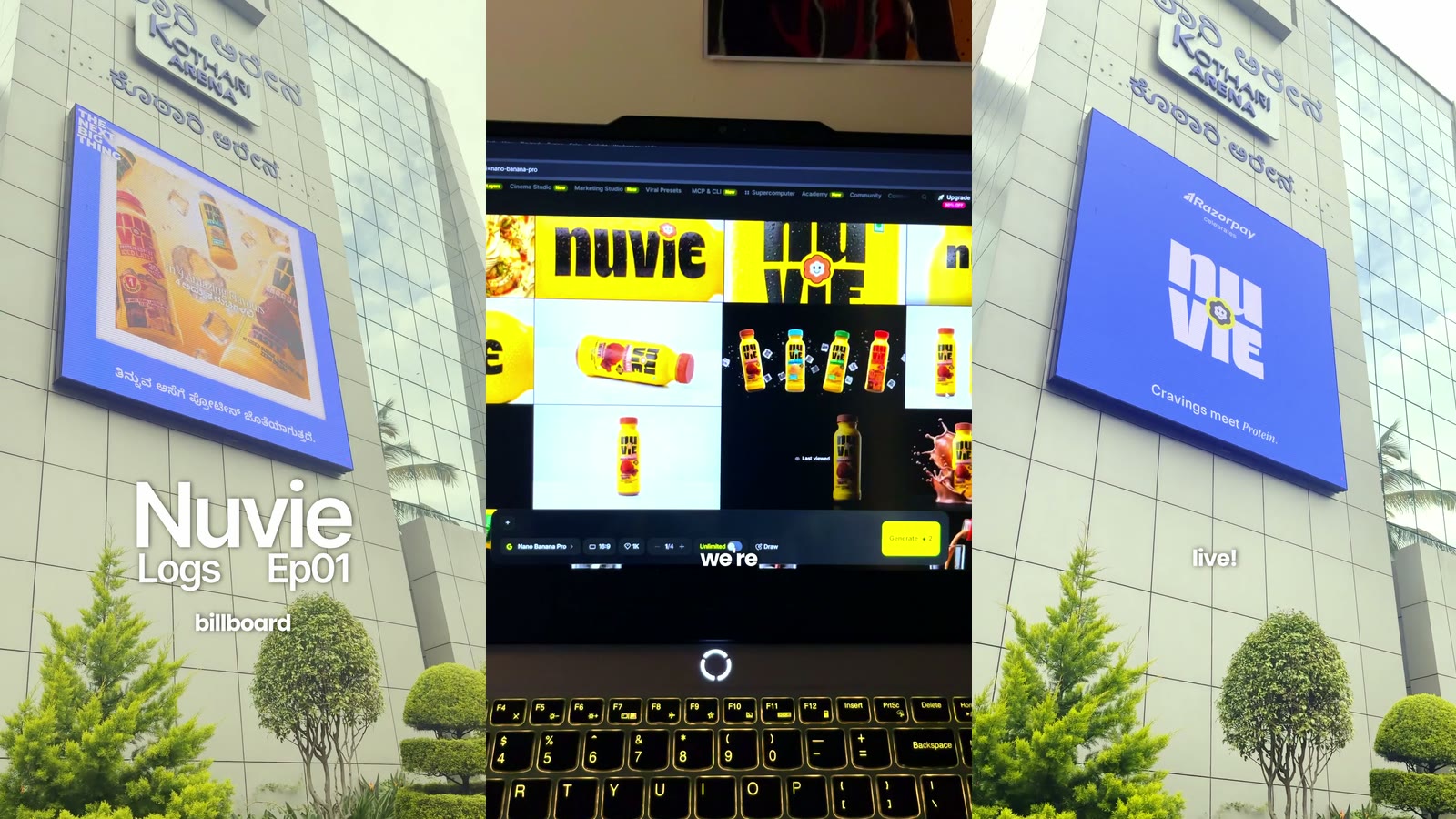
Nuvie's reel about the billboard shows the process, so we can too. Each shot was written out in plain words first. One of those prompts is on screen in the reel. The bottle "tilts in from the upper right, mid-pour". There is "soft white foam building on the surface, a few droplets suspended". The background is "pure black". The label has to stay "sharp, legible and undistorted".
Two lines in that prompt are worth copying. One keeps "black negative space across the right of the frame for a text overlay": the picture is composed around words that are not there yet. The other says "No people, no hands, no invented text". A model left alone will happily write a new label for your product.
The pictures were made with an image model, with Nuvie's real bottle as the reference (Nano Banana Pro is the one on screen in the reel). They were then turned into moving shots and cut to 15 seconds with the type.
On the wall
The ad went live on the billboard. A second, plainer product film was made for Nuvie the same way.
What this changes, and what it does not
For a small brand, the distance between "we got the slot" and "we have the film" used to be a budget and a few weeks. Here it was one working day.
The tools made the pictures. They did not choose them.
What it does not change is the thinking. Someone still has to decide what a stranger can take in from a moving car in two seconds, and what to leave out.
Nuvie ends its reel with a line for other founders, and we will borrow it. You may not get recognition for months when you are a startup. Keep showing up. One day someone notices, and puts you on a billboard.
When to make a product ad with AI, and when to shoot it
The Nuvie ad was made with AI because there was a slot on a billboard and no budget for a shoot. That is one good reason. It is not a reason to make every ad this way. The choice depends on what the film has to show.
AI is a fair choice when
- The product is alone in the frame. A bottle, a box, a jar, a book: a solid object with a clear shape, shown by itself. The prompt in Nuvie's reel says it in four words: no people, no hands.
- You can show the model the real product. A clean photograph of the actual pack is the anchor for everything that follows. Without it, the model draws a product of its own.
- The setting is simple, or impossible. A black background, one surface, a pour caught in mid-air. Simple settings hide what the tools are weak at, and impossible ones could not be filmed anyway.
- The film is short. A handful of shots of about two seconds each can be checked frame by frame. A long film with a story multiplies every problem.
- The date is close. When the slot is there this week and a shoot cannot be arranged in time, a careful AI film is better than an empty screen.
A real shoot is better when
- People use the product. A face, a hand closing round a cup, someone taking a bite. These are the things the tools get wrong most often, and the things viewers look at hardest.
- The customer will compare the picture with what arrives. A bakery's cake has to look like the cake in the box. Film the real cake.
- Touch and texture sell it. The crumb of a loaf, the weave of a cycling jersey, the paper of a book. A camera records what is there. A model draws what is likely.
- The same things must stay the same through many shots. One person, one room and one product through a whole story is hard to hold together with these tools.
- The message is that something is real. A dentist showing the clinic, a founder talking, a customer giving an opinion. If the point is that this is real, it has to be.
There is a middle way as well: photograph or film the real product properly, once, and use AI only for what surrounds it. It is the safest version, because the one thing that has to be accurate was never drawn by a model.
One test settles most cases. Put a frame from the film next to the product on the shelf. If a stranger could tell them apart, the film is not ready, however it was made.
How to plan an AI product ad: brief, references and prompts
The post above says what was done for Nuvie. This part and the next are the general method: how a job like this is organised from the first message to the finished film, whoever makes it. Most of the work comes before any picture is made.
1. The brief
Four things have to be known first: where the film will be seen, how long it is, whether it will be heard, and what a stranger should know at the end. A billboard is the hardest case. Nobody hears it and nobody stops for it, so each line gets about two seconds and says one thing. Nuvie's ad has one promise, four facts under it, and then where to get the product.
Write the lines before the pictures. The words decide how many shots there are, how long each one is held and where in the frame the text will sit. A film planned the other way round ends up with good pictures and no room for the message.
2. The references
Collect these before a single prompt is written.
- The real product. Clean photographs of the actual pack, from the front and from every angle the film will use, in even light. For Nuvie the reference was its real bottle.
- The brand's own files. The logo as artwork, the fonts, the colours and the label design. These go into the edit as they are. They are not left for a model to redraw.
- The look. Two or three pictures that show the light and the mood you want. They save a long conversation.
- The words. Every line that will be on screen, checked by the brand, in every language it will run in.
3. The shot list
List the shots in order, with the line of text each one carries. Keep every shot in one family: the same background, the same kind of light, the same distance from the product. A film made from one family of shots looks designed, and it is far easier to keep consistent.
4. The prompts
Each shot is then written out in plain words. A useful prompt has six parts. The one on screen in Nuvie's reel is a good model for them.
- The subject. The product, named exactly, with the reference picture attached.
- The action. One thing happening. There, the bottle "tilts in from the upper right, mid-pour".
- The detail that sells it. There, "soft white foam building on the surface, a few droplets suspended".
- The background and the light. There, "pure black".
- The space for words. That prompt keeps "black negative space across the right of the frame for a text overlay". The picture is composed around the type before the type exists.
- What must not happen. The label has to stay "sharp, legible and undistorted", and another line says "No people, no hands, no invented text".
The same six parts work for any product. For a made-up bakery, the prompt for one shot might read like this. A round loaf on a dark wooden board, cut in half, steam rising. Light from a window on the left, a plain dark wall behind. Empty space above the loaf for a line of text. The paper band with the bakery's name exactly as in the reference picture. No hands, no extra lettering.
Notice what is not in it: no adjectives about quality, no request to be striking. A prompt is a description of a photograph that does not exist yet. The more it reads like a note to a photographer, the more useful it is.
How to turn AI pictures into a finished ad
Once the stills exist, the job changes from writing to choosing and editing. The numbers carry on from the part above.
5. Make many, choose few
A model gives a different picture every time it is asked. So each shot is made several times, and most of the results are thrown away. Choosing is the real work at this stage. As the post above puts it, the tools made the pictures and did not choose them.
Choose in this order. Accuracy first: the product has to be exactly the product, with its real label, shape and colour. Then fit: the shot has to leave the space the text needs. Then family: it has to look as if it belongs with the shots already chosen. Beauty comes last. The prettiest picture with one wrong letter on the label is a reject.
6. Still first, movement second
Approve the still picture before it is made to move. Movement is the slower and less predictable step, and a fault in the still will be in every frame of the clip. For Nuvie, the pictures were made with an image model first and then turned into moving shots.
Ask for one simple movement in each shot: a slow push in, a tilt, a pour. Then watch the clip slowly, from the first frame to the last. A label that is correct at the start can bend or change in the middle of a move. Use the part of the clip that holds, and cut away before it stops holding.
7. The edit and the type
The chosen clips are cut to length, in the order of the lines. The text is added in the edit, by a person, in the brand's own font. It is not left to the model. That way every word is spelled correctly, sits in the space that was kept for it, and can be changed in a minute if the brand changes a line. The logo at the end is the brand's real file. If the type moves, it should have a reason to move, which is the subject of our post on motion graphics.
8. Sound
A billboard has no sound, so every frame of the Nuvie ad had to work without it. Most other places an ad runs do have sound. With generated pictures nothing was recorded, so every sound has to be made or chosen: a pour, a lid, a box opening, a cup set down on a table, and music that suits the pace of the cut. Build it shot by shot. Then check that the film still makes sense with the sound off, because a film that only works with sound fails on every silent screen. The layers are described in our post on sound design.
9. Finishing
Shots made one at a time never match perfectly. One grade over the whole film brings their colour and contrast together, and a fine layer of grain gives them one texture. We explain what a grade does in our post on colour grading. The film is then exported in exactly the size, shape and file type that the owner of the screen asks for. Ask for those requirements on the first day, not the last.
Last, look at the film the way it will be seen. For a billboard that means small, from across the room, a couple of seconds at a time, with no sound. For a phone it means on a phone, held in one hand. Problems that are invisible on an editing screen are obvious there.
What AI image and video tools get wrong in product ads
These tools are good at light, surfaces and mood. They are unreliable at exactly the things a brand cares about most. Knowing the weak points before you start is most of the skill, and each one has a workaround.
Text on packaging
An image model draws lettering the way it draws everything else: as a likely-looking picture. It does not check the result against your pack. As the post above says, a model left alone will happily write a new label for your product. It may misspell the name, invent a flavour, or replace the small print with marks that only look like letters.
The workaround has four parts. Give the model the real pack as its reference. Say in the prompt that the label must stay sharp, legible and undistorted, and that there is to be no invented text. Choose angles where the label faces the camera, because lettering seen at a steep angle breaks more easily. Then read every letter of every chosen picture at full size, with the real pack beside you. If a shot is right in every way except the label, the real label artwork can be laid over it in the edit and made to follow the product.
Logos
A logo drawn by a model is nearly right: a slightly different curve, a thinner line, a colour one shade off. Nearly right is wrong for a logo. Wherever the logo appears by itself, as on the last frame, use the brand's file. Where it appears on the product, compare it with the file before the shot is accepted.
Hands and people
Fingers, grips and faces are where generated pictures most often go wrong, and a hand that holds a product often changes the product as well. The simplest answer is the one in the Nuvie prompt: leave people out. If the film needs a hand, film a real one. A real hand with the real product, shot against a plain background, can be combined with generated surroundings in the edit.
Consistency between shots
Ask for the same jar of jam three times and you may get three jars: a different lid, a slightly different shape, a label that has moved. The light changes direction from shot to shot as well. Five habits hold a film together.
- Use the same reference pictures for every shot.
- Use the same words for the background and the light in every prompt.
- Choose a simple setting. A black background is the same black in every shot.
- Make the shots of one film in one sitting, and compare each new one with those already chosen.
- Grade the finished shots together, as one film.
Consistency is the hardest part of longer AI films too. We wrote about it in the making of an AI music video.
Liquids, steam and other things that move
Things that flow can look right in a still and behave oddly once they move: a pour that changes thickness, steam that turns back on itself, crumbs that drift upwards. Keep these shots short, keep the movement simple, and watch them at slow speed. The viewer has two seconds. Give each clip much longer than that.
The shape and size of the screen
Every screen has its own size and shape. A film composed for a phone will not simply fit a wide board, and a picture that is enlarged or cropped after it was made shows faults that were hidden before. Find out what the screen needs before the first picture is made, and compose for that shape from the start, with the space for text in the right place.
What to check before an AI-made ad is shown in public
An ad that can be made in a day can also go wrong in a day. Nothing made this way should go out because it looks good. These are the checks we would run on any AI-made ad before it is shown, in this order.
The brand's assets
- The product. Shape, lid, colour, size and label, compared side by side with the real pack.
- The logo. The real file, in the right colours, not a drawn copy.
- The words. Every line, number and claim on screen is the brand's own and agrees with what is printed on the pack. An ad should not say more than the product can support.
- The languages. If the lines run in more than one language, each one is checked by a person who reads that language every day. A model, and an editor who cannot read the script, will both miss a wrong letter.
Things that belong to someone else
Look through every frame for anything that is not yours: a pack that resembles another brand's, a face that resembles a known person, a building, a character or a work of art that someone owns. Models produce these without being asked. Check the music in the same way. And read the terms of each tool you used, to be sure that what it makes may be used in advertising.
The client's approval
The brand approves the finished film itself, not a description of it and not an earlier version. The simplest way is one link where the film plays and the client can pause on a frame and leave a note there, which is how our clients review every cut. If the film will run on someone else's screen, that owner sees it too, and their technical requirements are part of the brief from the first day.
Honesty about how it was made
Three rules keep an AI-made ad honest.
- Do not present it as something it is not. Do not call it a shoot. Do not show a result, a serving or a scene that the product cannot deliver.
- Say how it was made when it matters, and whenever you are asked. Nuvie's own reel about the billboard shows the pictures being made, which is why we can describe the process here.
- Follow the rules of the place where it runs. Some platforms and screen owners ask for a label on pictures made with AI, and advertising rules differ from country to country. Find out before the film is delivered, not after.
The reason is practical as well as moral. Someone who buys the product because of the ad will soon hold the real thing in their hand. The ad should have prepared them for exactly that.
Mistakes we see in AI-made product ads
Most weak AI ads fail in the same few ways, and none of them is about which tool was used. These are the mistakes we see.
- Starting with the tool. Pictures are made before anyone has decided what the film must say. The result is a set of attractive shots with nowhere to put the message.
- No picture of the real product. The model is given a description and draws something close. Close is a different product.
- Letting the model write. Text and logos are drawn into the picture, with small errors that nobody read closely enough to catch.
- Too much in one film. Six ideas in fifteen seconds. On a screen that people pass in a moment, one line at a time is all that can be taken in.
- Every shot from a different film. A new background, a new light and a new mood each time, because each picture was chosen by itself and never beside the others.
- Movement for its own sake. Spins, morphs and long travelling shots that start well and fall apart. A short, simple move that holds is worth more.
- Choosing the prettiest instead of the truest. The most striking picture is kept although the lid is the wrong colour.
- People added because the tool can. A smiling stranger with one finger too many, in a film that did not need anyone.
- Checked only on the editing screen. Never looked at in the size, at the distance and in the silence in which it will run.
- Approval skipped because the job was quick. A fast job needs the same sign-off as a slow one.
- Hiding how it was made. If it comes out later, people start to ask what else was not true.
Read the list again and the pattern is clear. Each mistake is a decision that was left to the tool. The fix is the same every time: a person decides, and the tool carries it out.
Checklist for making an AI product ad
A short list to work through, from the first message to the day the film goes out.
Before any picture is made
- You know where the film will run, its length, its size and shape, and whether it will be heard.
- The promise and the facts are written, in order, one line to a shot.
- The brand has checked every line, in every language.
- You have clean photographs of the real product from every angle the film uses.
- You have the logo, the fonts, the colours and the label artwork as files.
- You have asked the owner of the screen, or the platform, for their requirements and rules.
- You know who approves the film, and by when.
While making it
- Every shot is written out in words first: subject, action, detail, background and light, space for text, what must not happen.
- The reference picture is attached to every prompt.
- Each shot is made several times and chosen for accuracy first.
- Every label is read letter by letter at full size.
- Stills are approved before they are made to move.
- Each clip is watched slowly from the first frame to the last.
- Text and logo are added in the edit, from the brand's files.
- One grade and one layer of grain go over the whole film.
Before it goes out
- The product in the film has been compared side by side with the real one.
- Nothing in any frame belongs to another brand or resembles a real person.
- The film has been watched at the size and distance it will be seen, with the sound off.
- The file matches the requirements exactly.
- The brand has approved the final film itself.
- You can say plainly how it was made, and any label that is required is in place.
AI product ads, in short
The Nuvie ad shows that a short product ad can be made with AI in one working day. The method suits a product shown by itself in a simple setting, and a film that needs people, texture or proof that something is real should still be shot. The tools draw the pictures from a photograph of the real product, and people still write the lines, choose the shots, set the type and check every letter on the label. Before the film is shown, compare it with the real product, get the brand's approval and be open about how it was made.
Questions people ask
Can a product ad be made with AI, without a shoot?
Yes, for some ads. The Nuvie ad in this post was made with AI, with the brand's real bottle as the reference, and it went live on a billboard in Bengaluru. It works best when the product is shown by itself against a simple background.
How long does it take to make an AI product ad?
The 15-second ad in this post took eight hours from brief to finished film. We would not promise that for every job. The time depends on the number of shots, on how quickly the brand can supply its files and its lines, and on how quickly the film is approved.
Which AI tool was used for the Nuvie billboard ad?
The image model on screen in Nuvie's reel about the billboard is Nano Banana Pro. The pictures were made with Nuvie's real bottle as the reference and were then turned into moving shots. Tools change often, so the test we would apply to any of them is whether it keeps your real product and its label unchanged.
Will the product in an AI ad look exactly like my real product?
Only if the model is given clean photographs of the real product and every chosen picture is checked against it. The lettering on the label is what goes wrong most often, so it is read letter by letter. If it is wrong, the real artwork is laid over it in the edit, or the shot is made again.
Can AI get the text and the logo on my packaging right?
Not reliably. A model draws lettering as a picture and does not check it against your pack, so it can misspell a name or invent words. That is why the prompt in this post says "no invented text". The safe way is to add the type and the logo in the edit, from the brand's own files.
Should I tell people my ad was made with AI?
We think so. Do not present it as a shoot, answer plainly when you are asked, and follow any labelling rule of the platform or screen where it runs. Nuvie showed the making of its billboard ad in its own reel.
Do I still need an editor if AI makes the pictures?
Yes. The pictures are one step. Someone still has to decide what the film says, choose the shots that are accurate, cut them to length, set the type, build the sound and finish the colour. As this post puts it, the tools made the pictures and did not choose them.
What do you need from us to start an AI product ad?
Clean photographs of the real product, your logo and label artwork as files, the lines you want on screen, and where and when the film will run. We also need to know who approves it. The first call is free and lasts 30 minutes, and the rest of how we work is on our Services page.