Rav Ki Rasoi, Frame by Frame
Rav Ki Rasoi means Rav's kitchen. It is Ravya Arora's series. In each episode she takes one Indian sweet and makes a healthier version of it in under a minute: rasmalai, kaju katli, rose rabri.
Three teams make it. Ravya cooks and presents, and the series is hers. 91-11 Productions films it. We do the creative direction and the edit. This post takes three episodes apart, frame by frame, to show how the pieces fit.

- Every episode has the same six beats in the same order, so you know the show within a few seconds.
- Each episode has one colour: saffron for rasmalai, lilac for kaju katli, pink for rose rabri. The outfit, the type and the grade follow it.
- A new picture about every 1.1 seconds, and the last picture is the first one, so the reel loops.
Six beats, every time
Watch an episode with a stopwatch and the same six things happen in the same order. In the rasmalai episode:
- 0 to 3.5 secThe hook. The finished sweet, and one claim: more protein than two boiled eggs.
- 3.5 to 5 secThe title card.
- 5 to 7.5 secThe promise: “where we healthify your favourite mithais”.
- 7.5 to 9 secThe wheel. It is spun and lands on the sweet of the day.
- 9 to 37 secThe recipe, one step to a shot.
- 37 to 40 secThe wait, and the loop.
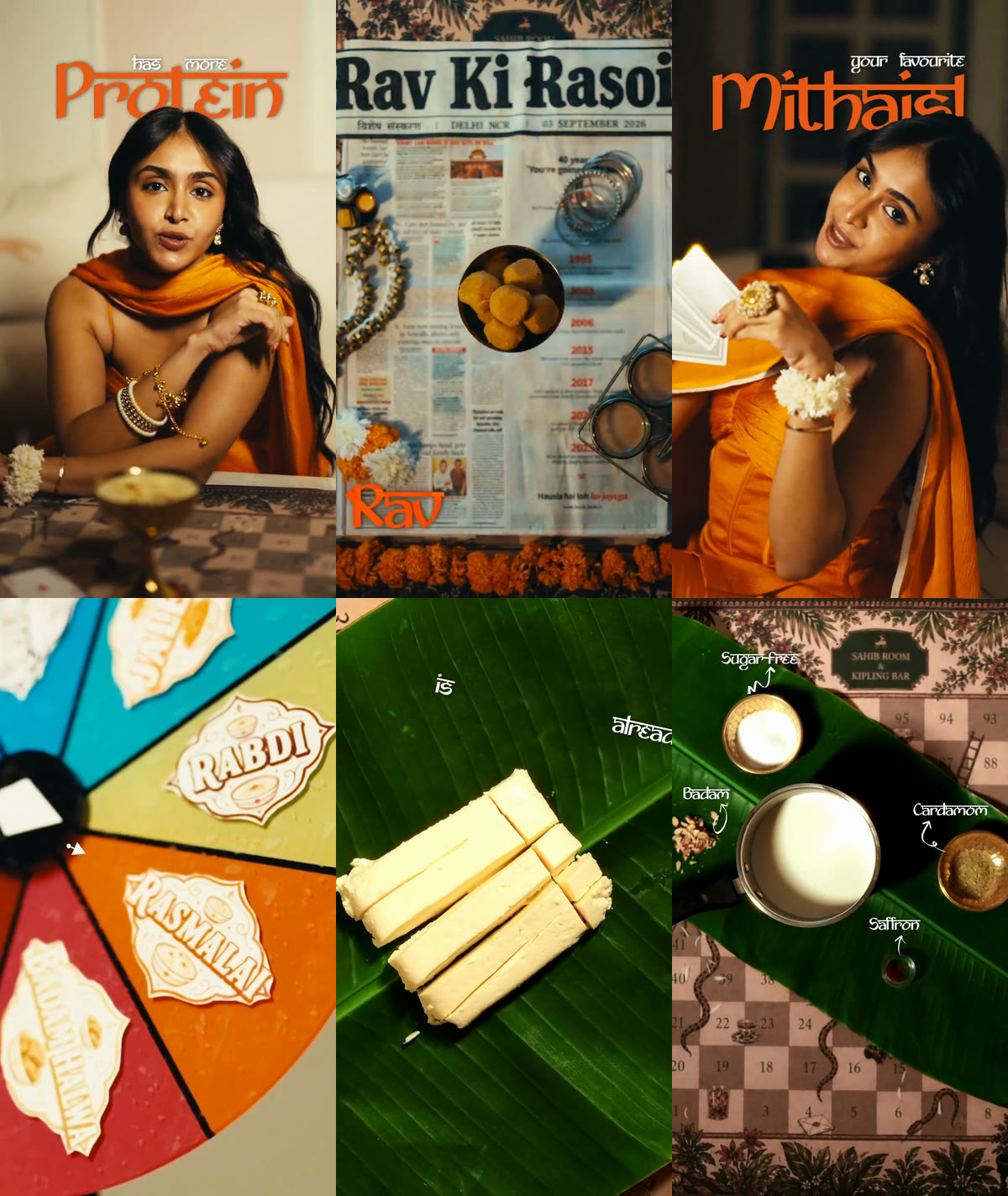
The other two episodes keep the order and move the times by a second or two. That is what makes it a series and not three recipes. The format is a promise about what comes next.
The hook
Each episode opens on the finished sweet, never on raw ingredients, and on a claim short enough to read: more protein than two boiled eggs, or “Half the calories”.
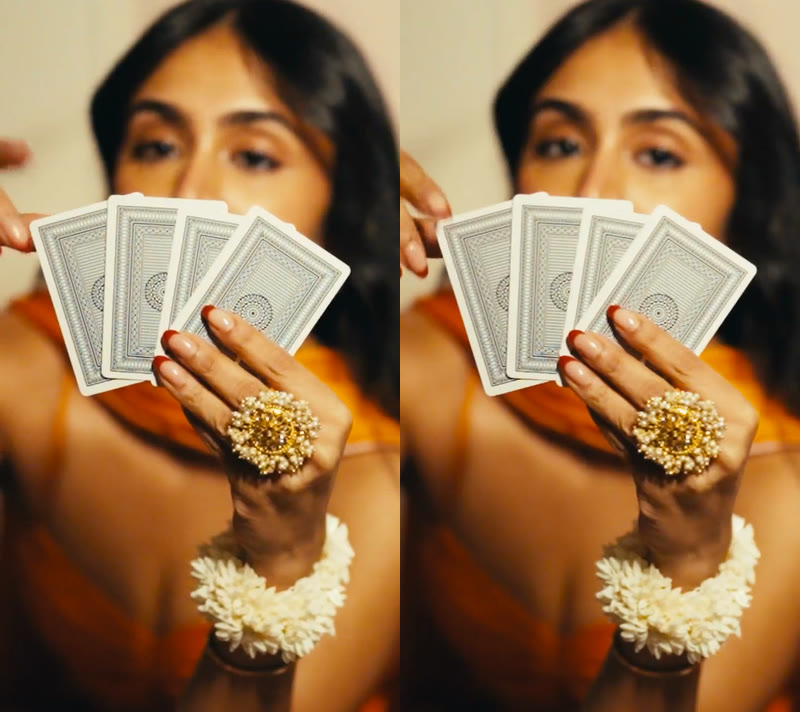
There is a game in every opening too. Playing cards for rasmalai. A chessboard for kaju katli, with the diamonds of kaju katli laid out like pieces. For rose rabri, a contest between the bowl and a lipstick: “which one disappears first”.
The title card
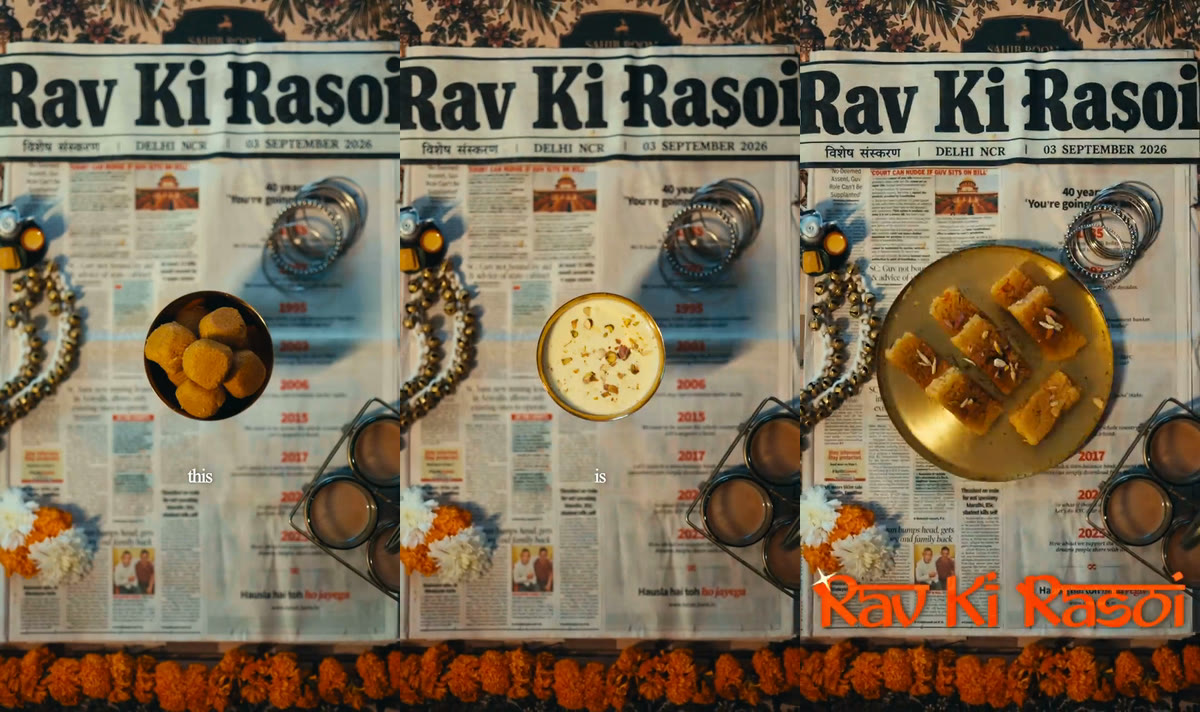
Then, for a second and a half, a newspaper. The masthead reads Rav Ki Rasoi, with an edition line under it: Delhi NCR, 03 September 2026. A brass plate sits in the middle of the page, and the sweet on it changes three times.
The newspaper, the masthead and the marigolds along the bottom are the same in every episode. A series needs one picture that does not change, and this is it.
The wheel
A paper wheel with the names of the sweets on it, spun by hand. The pointer lands on the sweet of the day.
It takes two seconds and does two jobs. It tells you what is being made. And it tells you there is more to come: rabdi, jalebi, besan laddu and milk cake are all on the wheel.
One step, one shot
The recipe is where most cooking reels slow down. Here every instruction gets its own shot and leaves when the sentence ends. The rasmalai episode changes picture about 36 times in 40 seconds, a new shot every 1.1 seconds. Kaju katli and rose rabri keep almost the same pace.
Two kinds of shot take turns. Ravya to camera, saying the step. Then the step itself from directly above, on a banana leaf: paneer cut into sticks and then into cubes, balls dropped into water, a rolling pin over the dough.
The ingredients get a frame of their own: bowls laid out on the leaf, with hand-drawn arrows and names that come on one at a time. Sugar-free, cardamom, saffron, badam, pista.
The type
Every line of speech is on screen, in two sizes. The small words come on one at a time, in white. The one word that matters is large and in the colour of the episode: Protein, Half, Boil, Rolling, Rose.
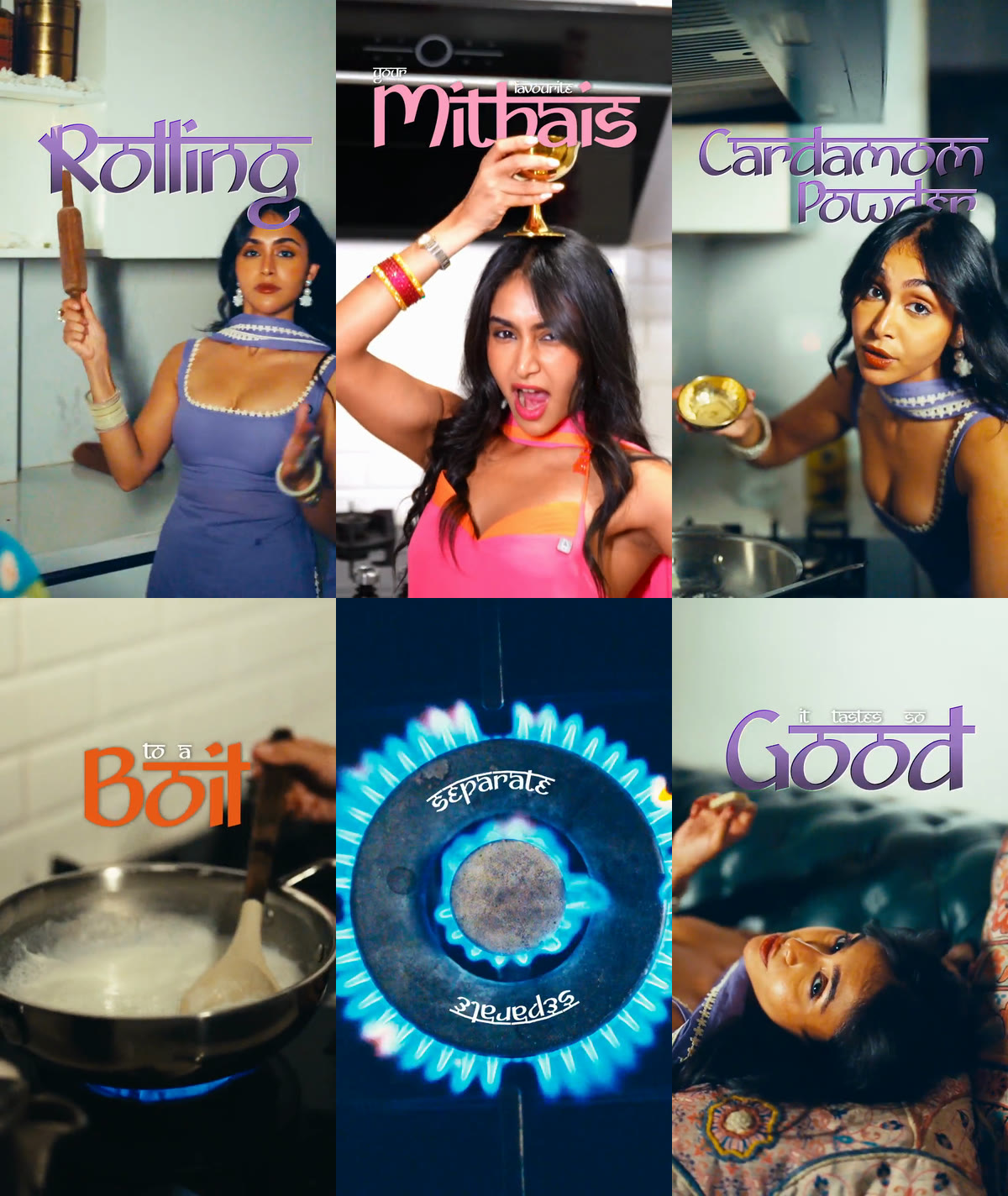
Look at where the large word sits. In several shots it is behind something: behind her head, behind the brass bowl she balances on it, behind the rolling pin she holds up.
Type does not go behind a person by itself. A mask is drawn around the hand or the pin, frame by frame, so that the letters pass behind it. It is slow work, and it is what makes the word look as if it were in the room.
On the gas burner the word “separate” is set in a ring around the flame.
The colour
Each episode has one colour. Rasmalai is saffron. Kaju katli is lilac. Rose rabri is pink. Ravya's outfit sets it, the type is matched to it, and the grade is built around it.
The light changes with it. Rasmalai is dark and warm, like a kitchen at night. Kaju katli is cool, with blue in the shadows. Rose rabri is bright and white.
Three things look the same in every episode: her skin tone, the green of the banana leaf and the brass. They are what make three different rooms read as one series.
The loop
The last picture of an episode is its first picture. Rasmalai ends on the fan of playing cards it opened with. Kaju katli ends back at the chessboard.
The sound loops as well. Kaju katli ends on the words “and that's why”, and the first line of the film finishes the sentence. Let it run and it starts again without a seam.
A format that can carry a brand
The rose rabri episode has a brand in it: a Maybelline lipstick, ordered on Blinkit, which arrives before the cooking starts.
Nothing in the format moves to make room for it. The title card, the promise and the wheel are where they always are. The lipstick gets the hook, where it is set against the rabri, and it gets the last line. Everything in between is still a recipe.
Three teams, one series
Ravya Arora is the reason the series exists, and it belongs to her. She cooks, she presents, and she plays every scene: the cards, the chess, the pan pulled off the shelf.
91-11 Productions filmed it. Every frame here was shot by them: the overhead shots on the leaf, the hands, the portraits.
We did the creative direction and the edit: the six beats, the cut, the type and the colour.
A format is only as good as the person in it and the pictures it is given.
None of it works without the other two.
How to build a repeatable format for a food series
The breakdown above describes one series. The sections that follow are general: how to plan, film and cut a recipe series of your own, whether you make it alone in your kitchen or with a team. Very little of it depends on equipment. Most of it depends on decisions made before the camera is on.
A format is a short list of beats that happen in the same order in every episode. The series above has six. Yours might have four or seven. The number matters less than the fact that it does not change from one episode to the next.
The reason is simple. Someone who has seen one episode knows where they are in the next. They know the dish is coming, when the recipe starts and how it ends. That is what separates a series from a folder of recipes.
What beats a recipe series needs
Start from the jobs an episode has to do, not from the shots. Most recipe episodes have the same five jobs: show the finished dish, say what the series is, say what today's dish is, cook it, and end. Give each job one beat. Then put the beats in an order you can keep for a year.
Give each beat a rough length, and keep everything before the recipe short. The recipe is what people came for. If the opening, the title and the introduction feel long when you read them aloud, they will feel longer on a phone.
What to keep the same in every episode
- One picture that never changes. A title card, a table, a doorway. It is how a viewer knows the series before a word is said.
- One line. A sentence that says what the series does, in the same words every time.
- The order. If the title comes second this week, it comes second every week.
- The way the words look. One typeface and one way of setting it.
Other things should change, or the series goes stale: the dish, the small idea in the opening, and perhaps one colour or one prop that follows from the dish. Write the two lists side by side, fixed on the left and free on the right.
Test the format on paper before you film. Say a bakery wants a series about one loaf a week. Write three episodes, one page each. If the third page is hard to fill, the format is too narrow. If the three pages read like three different shows, it is too loose.
There is one more test. Try to fit in something you did not plan for: a guest, a festival special, a sponsor's product. A good format has a place for it without moving anything else. The rose rabri episode above is an example: the brand takes the hook and the last line, and every beat stays where it was.
How to film a recipe so it cuts well
A recipe reel is half edited on the day it is filmed. If every step exists as its own clean shot, the cut is mostly a matter of order and length. If the recipe was filmed as one long take, the editor has to dig the steps out of it, and it shows.
Film one step in one shot
Write the recipe as a list of short sentences with one action in each. Each sentence is one shot. Start recording before the action begins and stop a second after it ends, so there is room to cut on either side.
Record each spoken line as its own take as well, with a pause before and after. A line that runs into the next one cannot be trimmed without clipping a word.
Use two camera positions
Two positions are enough for most recipes. One faces the cook. The other looks straight down at the work surface. Going from one to the other gives the edit its rhythm. If you have one phone, film the steps from above while you cook and record the lines to camera afterwards.
Fix the overhead camera to something solid. Mark the surface with tape just outside the frame, so the board or the bowl goes back to the same place after every step. If the frame drifts between steps, every cut will jump.
Shots to film for every recipe
- The finished dish. It opens the reel, and it is filmed last, when everyone is tired. Choose its plate, its place and its light before you start cooking.
- The ingredients, laid out. One frame with everything in it, held for a few seconds, with empty space left for the names.
- Every step from above. Hands come in, the action happens, hands go out.
- Every line to camera. Two takes of each line and three of the first one.
- The waiting. A lid going on, a timer, a fridge door closing. Two seconds is enough to say that time has passed.
- Close details. Steam, a pour, a knife going through. Ten seconds of each. They cover a join when a step runs long.
- The opening picture again. If the reel is meant to loop, film the first picture a second time at the end, so the last shot can match it.
Keep the light the same from the first step to the last. If the window is doing the work, switch off the ceiling light and finish before the sun moves. A dish that changes colour between two steps looks like two different dishes.
Watch the small things that have to match. The same bowl, the same spoon, the same sleeve rolled up. Wipe the surface between steps. A viewer may not be able to name what changed, but a cut where the bowl has moved reads as a mistake.
This is the kind of planning we do with a client before a shoot. If you film yourself, we set up every line for you: what to film, the camera angle and the light. If a videographer films, we brief them. The steps are on our Services page.
How to edit a cooking or recipe reel, step by step
Footage filmed that way more or less tells you how to cut it. This is the order we would work in.
- 1. Lay the voice down first. Put the spoken lines in order and take out the pauses and the repeats. Then listen with your eyes shut. If the recipe makes sense as sound alone, the structure is right.
- 2. Put one picture on each sentence. The shot of a step goes over the line that describes it and leaves when the sentence ends.
- 3. Trim each shot to the moment it is understood. A pour does not have to finish. Once the viewer has seen what goes into what, the shot has done its work.
- 4. Cut on movement. Change picture while a hand is still moving, not after it has stopped. The eye follows the movement across the cut.
- 5. Shrink the waiting. Boiling, setting and chilling get one short shot and one word on screen.
- 6. Build the opening last. By now you know your best picture of the finished dish and your strongest line. Put them first.
- 7. Decide the ending. Either the dish is served, or the last frame returns to the first so that the reel can start again.
Pace is the part people worry about most. The episode timed above changes picture about every 1.1 seconds, and it can do that because every instruction has its own shot. Speed is not the aim. Clarity is. If a viewer would have to pause to follow a step, hold that shot longer and take the time back from somewhere else.
The opening deserves more care than any other three seconds of the reel. Begin on the finished dish and one short claim that can be read at a glance. We have written a whole post about the first two seconds of a video, and it applies to food as much as to anything else.
How to record and mix sound for a cooking video
Food is one of the few subjects where sound does part of the work of the picture. A knife on a board, oil when something goes into it, a spoon against a steel bowl: a viewer knows these sounds already. Leave them out and the kitchen feels as if it were filmed through glass.
Record the voice close, with a small microphone on the cook. Kitchens are hard rooms, full of tile and steel, and there is usually a fan running. Switch off the fan and the fridge while a line is being said, and switch them back on afterwards.
Record the kitchen sounds separately, close to the pan, for about ten seconds each. In the edit they sit under the voice and come up a little in the gaps between sentences. Music sits lowest of all. If a viewer has to strain to hear a step, the music is too loud.
If the reel loops, let the sound loop too. One way is described above: the last line is left unfinished, and the first line of the film completes it. There is more on mixing in our post on sound design.
How to put text on a food video
On-screen text in a recipe reel has two jobs. It lets someone follow the recipe with the sound off, and it tells the eye which word in a sentence matters. Text that does neither is decoration, and it can go.
- A few words at a time. Three or four words on screen, replaced as the sentence moves on. A full sentence in one block covers the food and is still being read when the shot has gone.
- Two sizes, not five. One size for the spoken line and a larger one for the word that matters. The series above works this way.
- One typeface for the whole series. Choose it once. Changing it every episode undoes the work the format is doing.
- Colour with a reason. White for the line, and one colour for the large word, taken from the dish or from the colour of the episode.
- Keep it off the food. Put the words in the empty part of the frame. If there is no empty part, the shot was framed too tight, and that is worth knowing before the next shoot.
- Stay away from the edges. Apps put their own buttons and captions over the edges of the frame. Keep your words well inside it.
- Write the amounts down. Quantities, temperatures and times are the hardest things to remember by ear. Put them on screen as figures.
- Name the ingredients once. One frame, each ingredient labelled, the names arriving one at a time. After that the recipe can use the names without explaining them.
Then there is type that sits inside the picture: a word behind a hand, around a pan, or lying on the table. It is made by drawing a mask around the object, frame by frame, so the letters pass behind it. It is slow work. Spend it where it counts, on the one large word in a shot, and not on every caption.
Movement follows the same rule. A word can arrive with a small motion, but it should arrive on the beat of the sentence and then hold still long enough to be read. Text that never stops moving is competing with the food, and the food should win.
Check the result on a phone, held at arm's length, with the sound off. If you can follow the recipe from the text and the pictures alone, the type is doing its job.
How to colour grade food videos
Food is unforgiving about colour. Everyone knows what cooked rice, milk and a ripe tomato look like, and a wrong one looks unappetising even to a viewer who could not say why.
- Get white right first. Find something in the frame that should be white: a plate, milk, a cloth. Correct the shot until it is. Strange-looking food is very often a white balance problem, caused by two kinds of light in one room.
- Keep the food true and grade the room. The mood of an episode can be warm, cool or bright. The dish should still be the colour it was on the table. Change the walls, the shadows and the background, and protect the food.
- Go easy on saturation. Pushed too far, tomato soup turns orange and herbs turn neon. Raise the colour until the dish looks the way it did in the room, then stop.
- Protect skin. Hands are in almost every shot of a recipe. If the grade that flatters the dish turns the hands grey or red, the whole picture feels wrong.
- Choose anchors. Pick two or three things that will look the same in every episode, whatever else changes. In the series above they are the skin tone, the green of the banana leaf and the brass.
- Match shot to shot. The overhead camera and the front camera rarely agree. Put two shots of the same dish side by side and match them before you do anything creative.
The most useful colour decision is made before the shoot, not in the grade. If an episode is going to have a colour, then the clothes, the cloth on the table and the props have to carry it on the day. A grade can support a colour that is already in the picture. It cannot invent one convincingly.
Judge the grade on a phone as well as on the screen you worked on, and look at it next to the last episode. On a profile the episodes sit side by side as small pictures, and the row should look like one family.
We go further into this in our post on colour grading for social video.
Mistakes that make food reels look amateur
These are the mistakes we see most often in recipe reels. Each one has a plain fix.
- Opening on raw ingredients. The viewer does not yet know what they are waiting for. Open on the finished dish.
- One long take, sped up. Speeding footage up is not editing. Hands blur, the sound is lost and no step is clear. Film each step as its own shot.
- Mixed light. A window on one side and a yellow bulb above, so half the dish is blue and half is orange. Use one kind of light.
- A hand-held overhead shot. A phone held above the pan moves with every breath. Fix it to something.
- Text over the food. The dish is the subject. The words go beside it.
- Music louder than the cook. If the step cannot be heard, turn the music down or choose a quieter track.
- A silent kitchen. Pans and knives with no sound make the food feel far away. Record them.
- Every step the same length. Cracking an egg and folding a dough do not need the same time. Give each step what it needs to be understood.
- A new look every episode. New typeface, new colours, new order. Each reel may be fine alone. Together they do not add up to a series.
- Too much before the recipe. A greeting, a joke, a title and an introduction before the first step. Choose one opening idea and get to the cooking.
- A cluttered frame. A cloth, a phone charger and yesterday's cup at the edge of the shot. Clear away everything that is not in the recipe.
- An ending that just stops. The last step is not an ending. Serve the dish, or go back to the opening picture.
None of these needs new equipment to fix. They are all decisions, and most of them are made before the camera is switched on.
Checklist for planning a recipe episode
Go through this list before each episode. When every line has an answer, the shoot and the edit both get easier.
- The dish, in one line. What it is, and why someone would want to make it.
- The claim. One short sentence for the opening. It must be true, and it must be readable at a glance.
- The beats, in order. The same list as the last episode, with a rough time beside each.
- The script. Every step as one short sentence, written the way the cook talks.
- The shot list. One shot for each sentence, marked front or overhead.
- The opening picture. Where the finished dish sits, on what, and in what light.
- The colour. The colour of the episode, and what will carry it: clothes, cloth, props.
- The fixed things. Title card, series line, surface and typeface, all the same as before.
- The ingredients. Measured and in bowls before the camera is on, so that nothing is weighed on screen unless weighing is a step.
- Light and sound. One kind of light. A microphone on the cook. Fan and fridge off while lines are said.
- The extra shots. Steam, pours, the waiting, and the opening picture a second time if the reel loops.
- The large words. The one word in each line that will be set large. Choosing them now saves time in the edit.
- The ending. Served or looped. If it loops, write the last line and the first line together.
For a series, fill in the list for a batch of episodes at once and film them together. The fixed things are then set up once, and the episodes match because they were made side by side.
What makes a recipe series work
A food series is a set of decisions made once and then kept: the beats and their order, one picture that never changes, one way of setting type, and a few colours that stay true. The filming serves those decisions by giving every step its own shot. The edit then has one job, which is to make each step clear and move on. If you want help building a format of your own, start at our food page: the first call is free.
Questions people ask
How long should a recipe reel be?
As long as the recipe needs once the waiting is taken out, and no longer. The rasmalai episode in this post runs 40 seconds. If your cut feels long, look for a step that is shown, said and written all at once: one of the three can usually be shortened.
Do I need a professional camera to film recipes?
No. A phone fixed in place, one kind of light and a small microphone do more for a recipe reel than a better camera. The difference comes from planning each step as its own shot.
How many shots does a recipe reel need?
Count the sentences in your script: each step is one shot. Add the finished dish, the ingredients laid out and a few close details. Film a little more than you think you need, because a spare shot is easier than a second day in the kitchen.
Should a food reel have a voice or only text?
Either can work. A voice gives the series a person, while text alone has to carry every step and needs longer on screen. Choose one for the series and keep to it. Even with a voice, put the lines on screen for anyone watching with the sound off.
How do I make a reel loop?
End on the picture you opened with, filmed the same way. Then write the last line so that the first line completes it, as the kaju katli episode in this post does. Play the result three times in a row and check that you cannot tell where it starts again.
Can a brand be part of a recipe series?
Yes, if the format has a place for it. In the rose rabri episode above the product gets the hook and the last line, while the title card, the promise and the wheel stay where they always are. Decide those places before the shoot and leave the recipe alone.
Can you edit a food series that someone else films?
Yes. In the series in this post another team films, and we do the creative direction and the edit. We can also brief your videographer before the shoot, set up every line for you if you film yourself, or film with our own crew anywhere in India.
How many episodes should I plan before posting the first?
Write at least three on paper to be sure the format holds, and film a batch together so the fixed things are set up once. With us, every client's first month is eight videos. After they are posted we look at what worked and what did not, and the next batch is built on that.